
Before you read any further, I want you to try something. (I know, starting out a blog with homework?! But I promise, it’s worth it.)
Open ChatGPT and search for yourself. Or ask Google’s AI what it says about wedding photographers — or florists, or planners — in your city.
What comes up? If the answer is “nothing” or “not much,” you’re not alone. That gap is exactly why this guide exists.
84% of individual wedding vendors have zero AI citation share.
Zero. That’s not a rounding error or a niche problem. That’s the overwhelming majority of wedding photographers, florists, planners, and venues showing up nowhere when a couple asks AI for a recommendation. This comes from the 5W Wedding Industry AI Visibility Index (May 2026), which ran dozens of real consumer-intent prompts through ChatGPT, Claude, Perplexity, and Google AI Overviews and tracked which vendors actually got mentioned. For 84% of vendors, the answer was nothing at all.
Here’s the thing though: the couple planning their 2027 wedding is using AI the same way you used Google back in 2010. It’s already happening. The question isn’t whether AI matters to your business, it’s whether AI knows you exist. Right now, for most vendors, it doesn’t. That’s what we’re fixing today.
First, the Good News: You’re Not Starting From Zero
If you’ve spent years doing the “right” SEO things (keywords, backlinks, good content, a fast website) I don’t want you to feel like all of that just became worthless overnight. It didn’t. Think of it this way:
| What You Know (SEO) | What’s New (GEO) |
|---|---|
| Using the right keywords | People Googling your name directly |
| Other sites linking to you | How often you’re mentioned online |
| High-quality content | Being seen as the expert |
| A fast, well-built website | Writing that AI can easily read |
Notice something? The right column isn’t a different game. It’s an evolution of the left one. Same instinct, new measurement. A lot of what you’ve already been doing still counts, we’re just adding a layer on top of it. (And to be clear: local SEO still matters, a lot. Your Google Business Profile is still one of the most powerful things you can maintain for local visibility.)
So what exactly is this new layer? GEO stands for Generative Engine Optimization, and here’s the simplest way to think about it: SEO gets you found in a list of links. GEO gets you mentioned in an AI’s answer.
Instead of competing for position one out of ten blue links, you’re competing to be the source AI actually pulls from when it writes a response, and there are a lot fewer spots in an AI answer than there are on a search results page.
How AI Actually Search Answers a Question For Wedding Couples
Here’s what’s happening behind the scenes when a couple asks AI something like “unique outdoor wedding venues near me.”
AI doesn’t process that whole sentence at once. It breaks the question into several mini-searches running at the same time, different angles on the same core question. It pulls results from each one, reads them, and looks specifically for sources that answer multiple parts of the question in one place. Those are the sources it ends up citing.
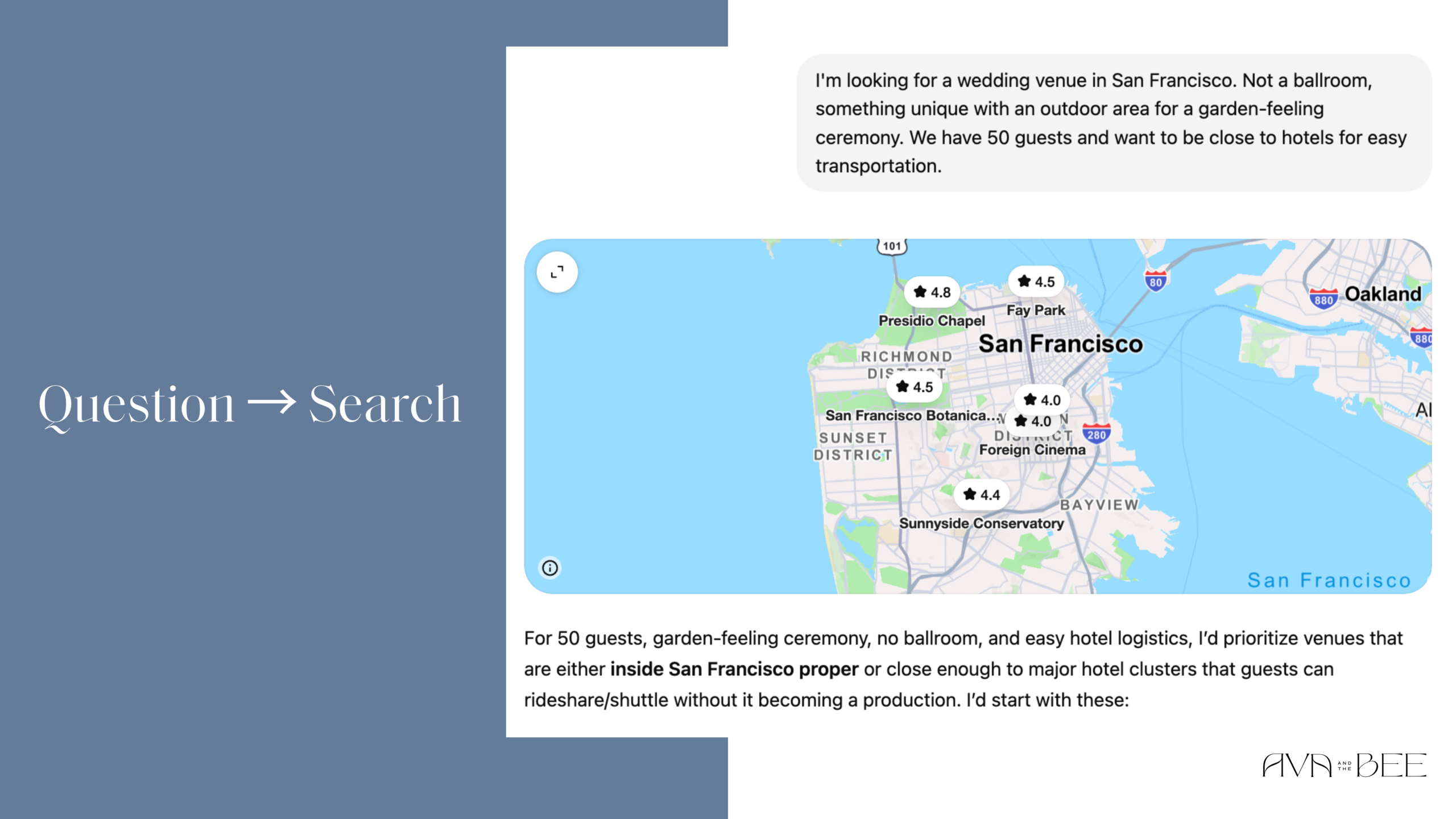
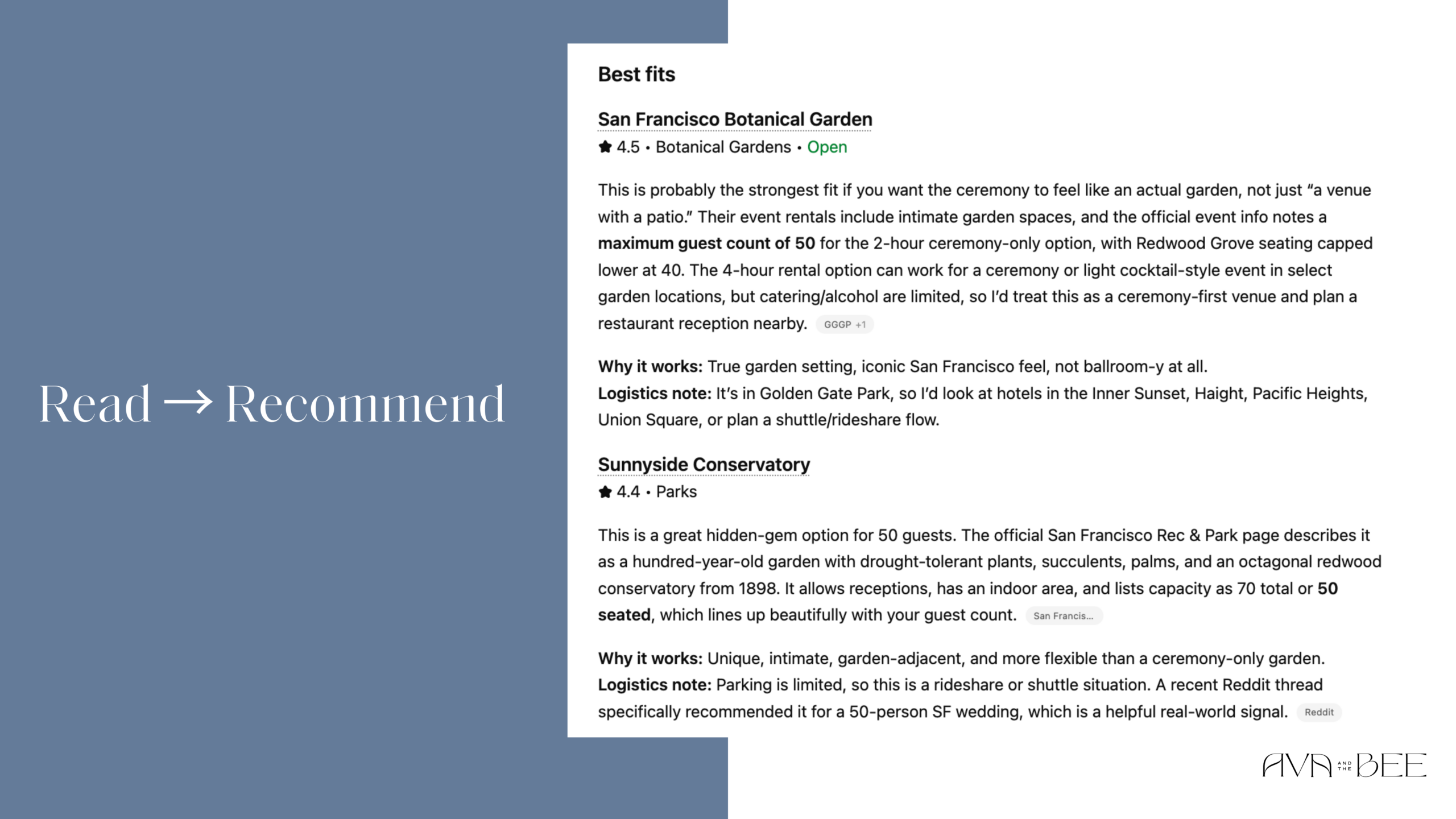
Then it synthesizes everything into one conversational answer. It might recommend three venues by name, pull a quote from a wedding blog review, or reference a directory listing, and it doesn’t always link back to the vendor’s actual website.
The takeaway: if your website, directory profiles, reviews, and blog posts collectively answer the descriptors a couple is searching for, AI connects the dots and puts your name in the answer. If they don’t, it moves on to someone whose content does.
A few platform notes worth knowing, since couples aren’t just using one:
- ChatGPT is the most widely used, tends to favor big established sources, and typically cites 3-4 sources per answer. It’s the hardest to break into as a smaller vendor, but the most valuable when you do.
- Google AI Overviews & Gemini live right inside the search couples already use every day, and they’re heavily influenced by your existing Google presence — your Business Profile, reviews, and local SEO. If you’re already doing the Google basics well, this one tends to follow.
- Perplexity is genuinely the best opportunity for smaller and niche vendors. It cites around 13 sources per answer, surfaces local players, and rewards specific, detailed content.
What Makes AI Search Trust You Enough to Cite You As a Wedding Vendor?
There are four things AI is quietly evaluating every time it decides who to recommend.
- Writing AI can actually read. Clear headings, direct answers, FAQ sections, organized content, AI can use that. Vague copy and walls of text? AI moves right past it. If your homepage just says “a beautiful space for your special day,” AI has nothing concrete to work with.
- How often you’re mentioned online. Is your business showing up in more than one place, like The Knot, WeddingWire, Zola, local directories, and Google reviews? This is about breadth. Every mention is a data point, and AI is counting them. If you don’t have directory listings, a Google Business Profile, or reviews, AI simply has nothing to point to.
- Whether you’re seen as the expert. Are you quoted, featured, or referenced by other credible sources? This is the one you actually have the most control over! Through blog posts, being mentioned by other vendors (“we always book Sarah for outdoor weddings”), press features, and podcast appearances. It’s someone other than you saying you’re good at what you do.
- Whether people are Googling your name. This is the big one. Brand search volume is the number one predictor of whether AI cites you (The Digital Bloom, 2026). When someone searches your actual business name — not “wedding photographers near me,” but you by name — AI reads that as real-world proof that people know you, trust you, and are actively looking for you. You can’t fake this one. It’s earned.
Four Signals You Can Start Working On This Week
1. Show Up Everywhere Online
If AI can only find you in one place, like ust your website, or just Instagram, it’s not confident you’re a real, established business. But when it finds you consistently across The Knot, WeddingWire, Google, and a local wedding blog, that’s trust. That’s presence.
Vendors with complete profiles across multiple directories are 3x more likely to be cited by AI than those without (SE Ranking, 2025).
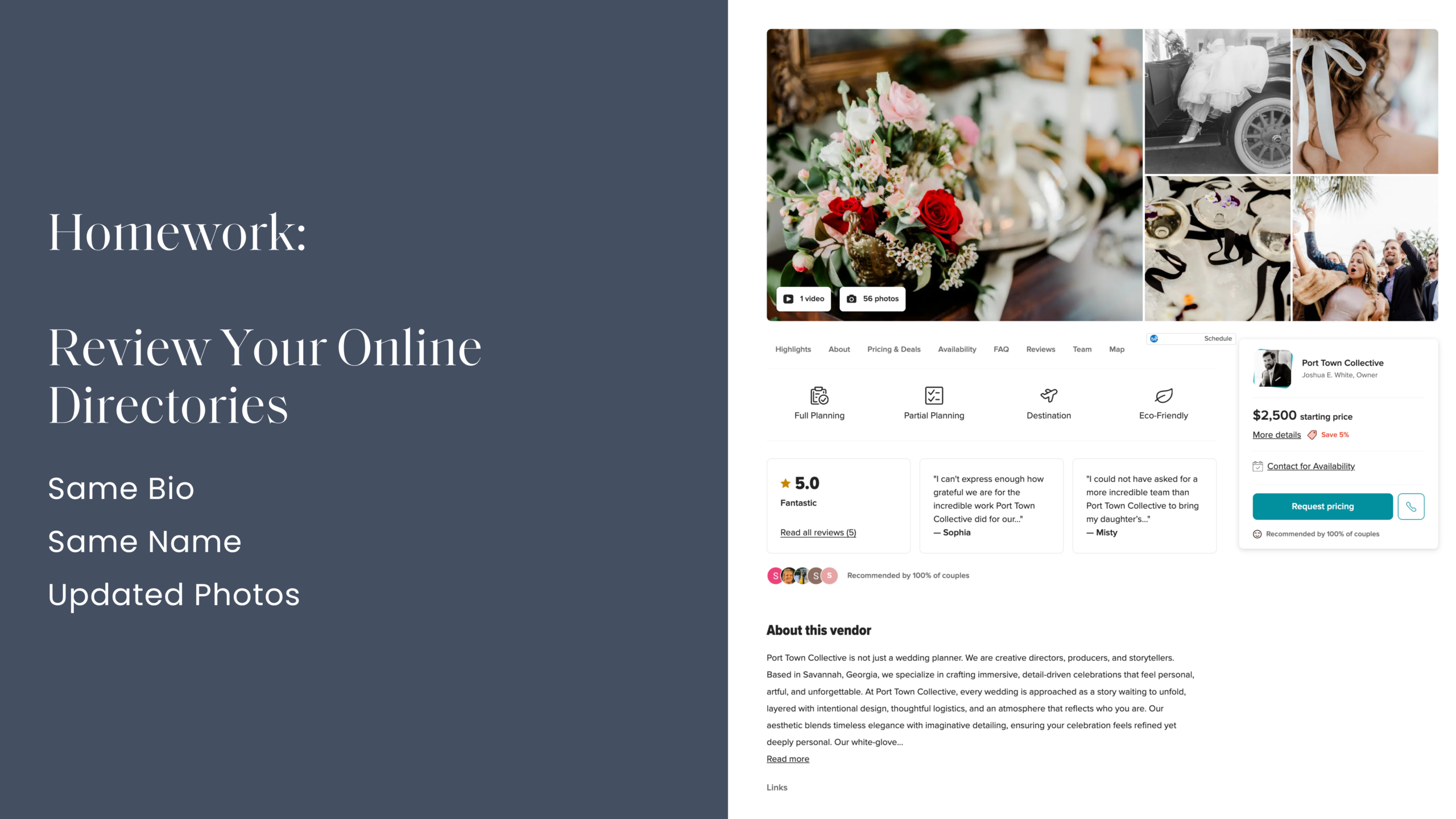
Your homework here is simple but exacting: go to your Google Business Profile today and check that your bio is written in full sentences, includes the keywords you want to be known for (think “garden wedding venue for elopements,” not just generic phrasing), and that your business name is spelled identically everywhere it appears online.
This last part matters more than people realize! If you’re “Sarah’s Flowers” on Google, “Sarah’s Floral Design” on The Knot, and “Sarah’s Floral” on your own website, AI treats those as three different businesses. The signals don’t add up. Make sure your photos are current, and you’ve posted something in the last 30 days, too.
2. Get People Talking About You
About 70% of AI citations come from sources outside your own website (The Digital Bloom, 2025). What other people say about your brand carries more weight with AI than what you say about yourself.
AI is reading patterns in your reviews, how other vendors describe you, and words that repeat across multiple sources. If forty couples all describe working with you as “calm,” AI starts associating that word with your name. And if a planner writes that they recommend you because you’re “incredible in unexpected weather,” that sentence just handed AI your name, your specialty, and a personality trait all at once.
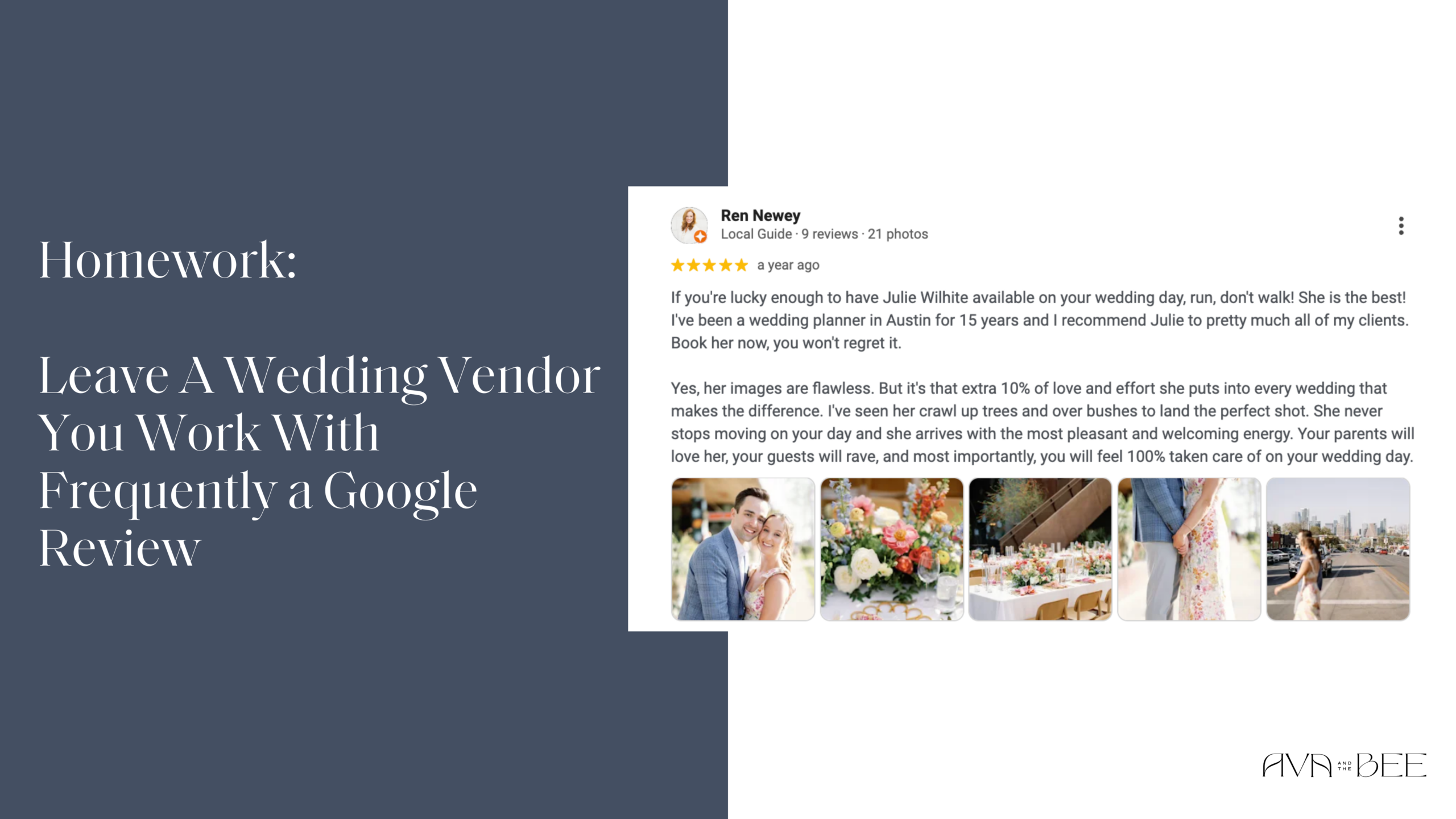
If you’re not getting many reviews, it’s usually one of two things: you’re not asking more than once (people are busy, you’ll likely need to follow up), or you’re making it too complicated. Fix this by having a page on your website ready to send couples, listing up to three places you’d love a review, with direct links. Give them a few prompts so they’re not staring at a blank box! Questions like why did you choose us, what’s your favorite memory from the day, or how would you describe the overall experience. This also gives you great snippets for social and future blog posts.
One action to take today: leave a Google review for a vendor you work with often. Then text them: “Hey, I just left you a review, would you mind doing the same for me?” Two minutes, and you’ve built a relationship signal, added to their count, and likely triggered a new review for yourself too.
[Read Our Full Blog On Getting Reviews]
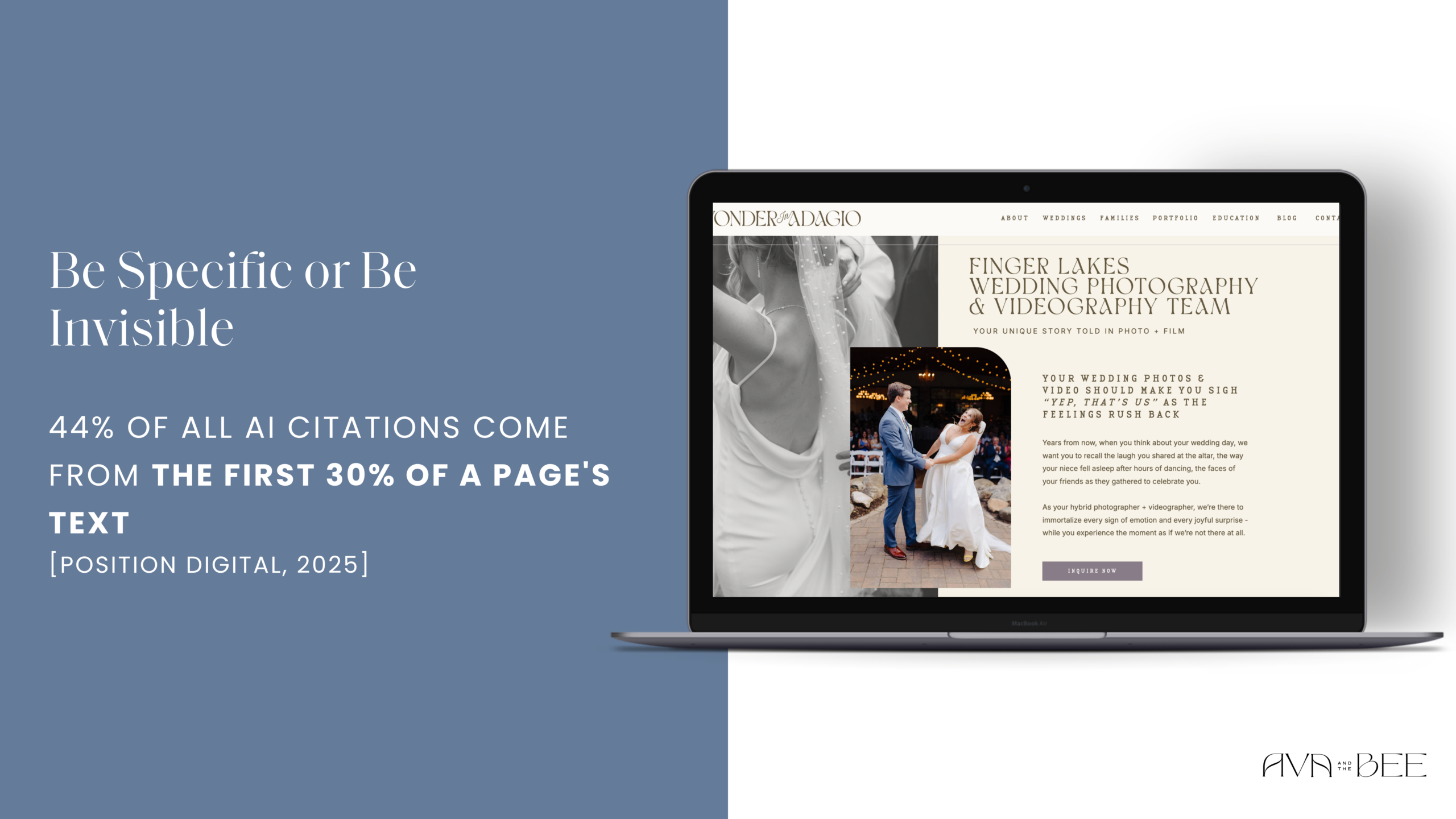
3. Be Specific or Be Invisible
44.2% of all AI citations come from the first 30% of a page’s text (Position Digital, 2025). If your answer isn’t up front, it doesn’t matter how good the content further down is.
This is really about positioning, and it’s the one issue that shows up on almost every vendor website. Go look at your own homepage. Does it say something like “destination photographer available worldwide” or “capturing love stories wherever they take us”? I understand the instinct. You don’t want to turn anyone away. But here’s what AI reads when it sees that: nothing. So when a couple searches for a photographer in their specific city, AI skips right past you. Not because you’re not talented, because it genuinely doesn’t know you serve that market.
Compare:
- ❌ “Destination photographer available worldwide”
- ✅ “Austin wedding photographer specializing in intimate elopements and micro-weddings in the Texas Hill Country”
That second version hands AI your location, your specialty, your style, and your reach, all in one sentence. Specific beats poetic, every single time. Pull up your homepage headline right now. Does it clearly say who you are, where you work, and what you do? If not, that’s tonight’s rewrite.
4. Answer the Questions Couples Are Already Asking
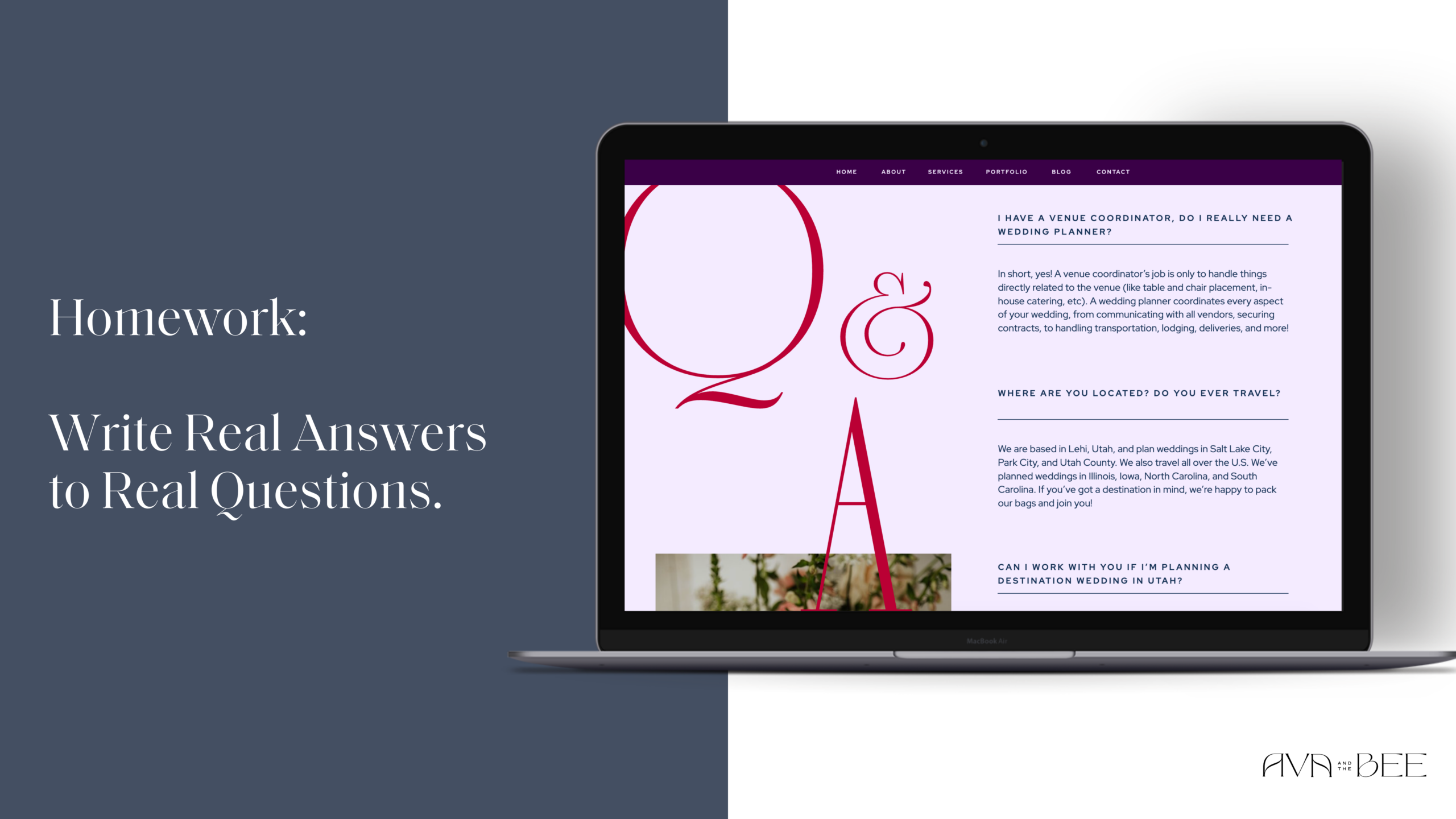
Adding an FAQ section is one of the single highest-return moves you can make right now. When a couple asks ChatGPT something like “how far in advance should I book a wedding photographer?”, AI is literally looking for a page that already has that exact question written out, with a clear answer directly beneath it.
Pages with FAQ sections are 3.2x more likely to appear in Google AI Overviews (Frase, 2025).
Think about what your couples actually ask you: “what’s included in your packages,” “do you travel outside the area,” “what’s your style.” Write real, specific answers, 50-100 words each. This doesn’t need to live on its own standalone page! Spreading FAQ content across your existing site pages actually tends to work even better.
While you’re at it: add pricing. It’s one of the most-searched planning questions couples ask AI, and most vendors avoid putting it on their site entirely — which is quietly costing them AI visibility. You don’t have to publish an exact number if that doesn’t feel right. An average (“most of our couples spend $5,500 on their photography package”), a range (“packages start at $4,000 for elopements and $8,500 for full wedding days”), or even a percentage-of-budget framing all give AI (and couples) something concrete to work with.
What This Looks Like in Real Life
Amber Vickery is a wedding and family photographer based in Austin, Texas, and a client of ours since 2021. Over the years, her ideal audience shifted, so we rebuilt her brand around it with new positioning, a clear focus on small, intimate weddings and family photography instead of trying to be everything to everyone, a steady rhythm of two blogs a month plus Pinterest and a monthly newsletter, and content structured in a way both Google and AI could actually read and use.
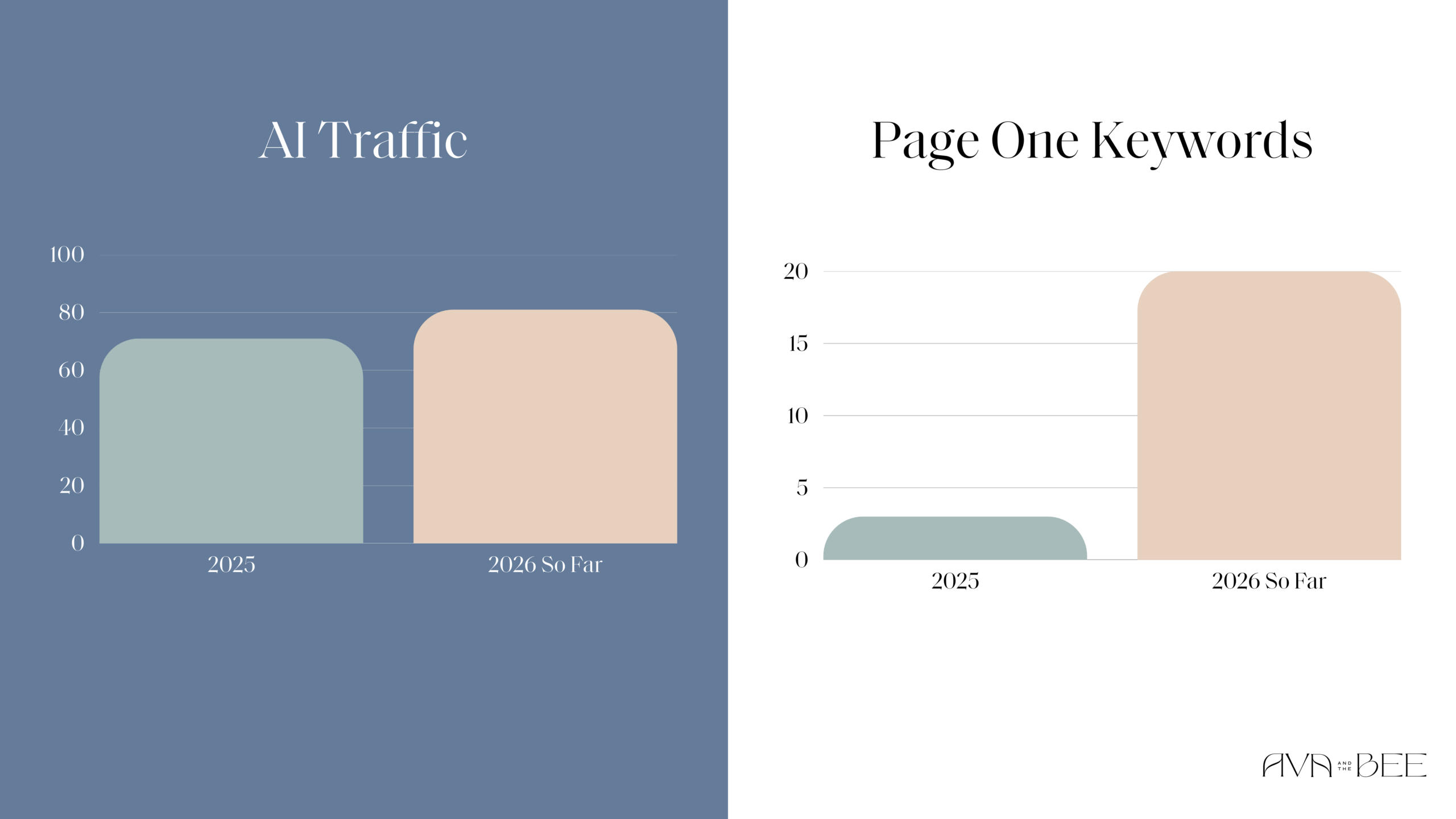
In 2025, Amber was ranking on page one of Google for 3 of her target keywords. Today, she’s ranking on page one for 20! And not just for low-traffic vanity terms. She’s ranking #1 for “Small Wedding Venues Austin,” “Wedding Venues for Small Intimate Weddings,” and “Small Wedding Venues”, a term that gets 12,100 searches a month nationally, where she now ranks in the top five.
Her AI visibility followed the same curve. In 2025, she showed up on exactly one AI platform (ChatGPT) generating 71 referrals to her site that year. In 2026, she’s showing up across ChatGPT, Perplexity, and Gemini, with 81 referrals already and the year still in progress.
None of that happened by accident, and none of it required a separate “AI strategy.” It happened because the same work that improved her Google rankings — the blogging, the clear positioning, the specific local keywords, the FAQ content, the consistent brand across every platform — improved her AI visibility at the exact same time. GEO and SEO fed each other.
You’ve Been Building These Signals All Along
If this feels like a lot of new information, here’s what I want you to actually take away from it: none of this is foreign to you. The reviews you’ve been asking for. The vendor relationships you’ve been nurturing. The press features you’ve pitched. The directory profiles you’ve kept up to date. The couple who found you because a planner mentioned your name at a bridal show three years ago. AI isn’t asking for something new and exotic — it’s looking for exactly what good vendors have always done: show up consistently, build real relationships, share real knowledge, and earn a reputation other people talk about.
The difference now is that AI is watching, and it’s actively deciding who to recommend based on what it finds.
Somewhere right now, a couple is opening ChatGPT and asking who to hire for their wedding. Most vendors in your category won’t show up in that answer. You now know some things most of your competitors don’t yet.
Where to start tonight (pick one):
- Review your online directory listings for consistency
- Update your couple review process with specific prompts
- Leave a review for a vendor you work with often
- Rewrite your homepage headline to be specific, not poetic
- Add an FAQ section to your services page
- Add pricing information to your website
Hire a Wedding Marketing Team To Do This For You
AI search isn’t slowing down, and it isn’t going away. It’s only going to keep evolving, which means staying visible isn’t a one-time fix, it’s an ongoing practice. That’s exactly where we come in.
At Ava and the Bee, this is the work we do every day for wedding professionals! From auditing exactly where you stand right now across Google, directories, and AI search, to building the full strategy that gets you found: blogging, Pinterest, brand positioning, website architecture, and everything in between. Whether you need a clear-eyed audit of what’s working (and what isn’t), or a complete brand and marketing transformation built around visibility from the ground up, this is what we specialize in.
We’ve been tracking this shift since 2024, and we’ll keep tracking it, so you don’t have to become an SEO and AI expert on top of running your business. That’s our job. Yours is booking the couples who are already looking for you. [Explore Our Services]


Reader's
Favorites



Copyright 2026 ®Ava And The Bee LLC | Branding and Website Design by With Grace and Gold | Copy by The Literary Co. | Privacy + Terms | Shop Terms